|
|
|||||||
|
|
|
|
|
|
|
|
|
|
|
|
|
|
|
|
|
|
|
Gold Seasonal Launchpad Adam Hamilton July 3, 2026 2595 Words
Gold’s brutal plummeting in June on Fed-rate-hike fears made for its worst month in nearly 18 years. All that carnage fueled heavy capitulation selling, forcing herd sentiment back to very-bearish and slamming gold into deep oversoldness. But such an irrational wildly-overdone selloff in gold’s seasonally-weakest month is very bullish. It set the stage for big mean-reversion gains as gold’s seasonal launchpad nears.
Gold just collapsed an astounding 11.6% in June, rivaling June 2013’s similar 11.2% rout and proving gold’s worst month since October 2008’s 16.3% crash! The latter happened during a stock panic, when the S&P 500 also crashed 16.8% and the US Dollar Index rocketed 7.8% on safe-haven flight-capital flows. Interestingly June 2013 was a lot like June 2026, also driven by unreasonable Fed-tightening fears.
In that June 13 years ago, gold was stable heading into its FOMC decision only down 1.4% month-to-date. In his post-meeting press conference, the Fed chair Ben Bernanke merely laid out a possible scenario where the FOMC might start tapering its QE3 bond monetizations later that year! Starting right then, over seven trading days the USDX surged 2.8%. That unleashed heavy selling hammering gold 12.3% lower!
Gold’s kneejerk reaction to the Fed then was highly-irrational. Bernanke said the FOMC could soon start to slow its bond buying, not stop it. That meant the Fed’s balance sheet would continue ballooning, which was bullish for gold. It had multiplied from $890b in assets before late 2008’s stock panic to $3,440b by then, and would still soar another $620b or so over the coming year even if the Fed did start tapering QE3!
It made no sense at all for gold to collapse then with the Fed’s huge monetary inflation still ongoing. Such a crazy overreaction to such little news would’ve been unlikely outside of June. It has always been gold’s weakest month of the year seasonally, the heart of its summer doldrums. Investors check out for summer vacations and fun, leaving low-volume trading which enables price moves to be dramatically exaggerated.
Gold’s QE3-taper-fear collapse blasted it back to extraordinarily-oversold levels at just 0.749x its 200dma near the end of June 2013. Proving that 12.3% seven-trading-day post-FOMC drop wasn’t righteous, over the next 2.0 months gold soared 18.2% in a powerful mean-reversion rebound! It regained its early-June levels a couple weeks before that FOMC decision. June 2026’s ugly gold action sure feels déjà vu-y.
Heading into Jobs Friday the 5th early last month, gold had been consolidating high for 2.3 months. But that May jobs report proved a huge upside surprise, so gold plunged 3.7% that day on Fed-rate-hike fears flaring. With recent months’ support suddenly shattered, bearishness surged. The following week, gold plummeted another 4.3% on the 10th as its backward war trade resumed after serious escalations in Trump’s war.
But gold bounced strongly out of that, surging 7.5% over the next five trading days into the latest FOMC decision at 2pm on the 17th. The first helmed by Trump’s new Fed chair, traders were closely watching. Kevin Warsh really emphasized fighting inflation over promoting jobs growth, and Fed officials’ federal-funds-rate projections were somewhat hawkish. Gold only fell 1.6% that day, like June 2013’s Fed Day’s -1.3%.
But over the next five trading days, gold collapsed 7.8% on a parallel 2.0% USDX surge again driven by traders expecting more Fed rate hikes. That heavy gold selling was irrational and wildly-overdone, as the FOMC hadn’t done anything. Actually Warsh’s bold new direction for the Fed could liberate gold, as he eliminated FFR forward guidance and will likely kill FFR projections which have spawned many big gold plunges!
That post-FOMC collapse hammered gold back to deeply-oversold levels at just 0.898x its 200dma, a 3.7-year secular low per that metric! Just like 13 years ago, I really doubt such an overreaction could’ve happened outside of gold’s low-volume summer doldrums. Had the FOMC done a big surprise hike that would be a different story, but all it did was merely emphasize the price-stability side of its dual mandate.
Also echoing June 2013’s example, such an extreme anomalous selloff leading into gold’s seasonal launchpad is very bullish. Gold again has great potential to enjoy a big-and-fast 20%ish rebound over these next few months. Last week I analyzed why gold is technically poised for a big reversal. Today I’m going to delve into the bullish seasonals buttressing the probabilities for a major mean-reversion rebound.
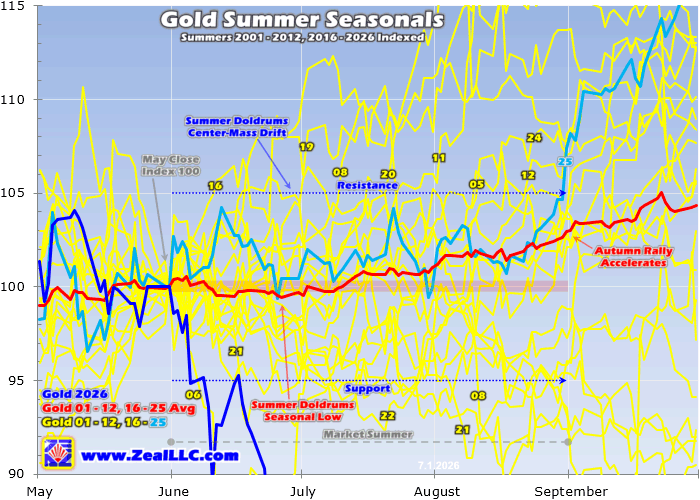
Gold’s summer doldrums are nothing new, this chart is updated from my latest early-June essay on them. It indexes all modern gold-bull-year summers since 2001 to 100 at May’s final closes, recasting their price action perfectly comparably. Gold’s Jobs Friday plunge made for a weak early summer, but then its war-escalation and post-FOMC plunges crushed it off this chart! Gold had crashed 12.2% month-to-date on the 24th!
June 2013 isn’t included here because 2013 to 2015 proved bear years for gold, where seasonals tend to act differently than bull years. But in the 23 modern gold-bull-year summers rendered here, 2026’s was both the worst in early June and exiting June at just 88.4 indexed! Initially I re-axised this chart to show all of 2026’s carnage, but it compressed the rest of this data too much. So some of the blue line is cut off.
The three previous worst June exits were just 93.0 indexed in 2021, 94.3 in 2006, and 94.9 in 2009. So June 2026’s craziness was in a league of its own during modern gold-bull years. Maybe gold is rolling over into another bear year, as on June 24th its total drawdown from late January’s extreme peak extended to 26.0% over 4.8 months! That is really excessive historically, far beyond norms after gold’s biggest bulls.
Yet gold had rocketed so fast in January that it exited June down just 6.8% year-to-date! That’s nowhere near bear-market-grade 20%+. And given other key bullish factors including gold’s serious oversoldness, speculators’ very-bullish gold-futures positioning, and American stock investors’ gold portfolio allocations still effectively nil, we need to give gold’s secular bull the benefit of the doubt. It likely remains alive and well.
And June 2026’s plummeting made no sense, it was anomalous. The FOMC didn’t do anything, and top Fed officials’ FFR outlook didn’t even surprise. On Jobs Friday, federal-funds futures were pricing in a single 25-basis-point rate hike later this year. Later on Fed Day, top Fed officials’ outlook for the FFR exiting 2026 was for that same lone 25bp hike! Yet gold’s post-FOMC rout left it 7.4% under Jobs Friday’s close.
Interestingly as you can see in this chart, gold’s summer-doldrums low tends to be carved in late June. That’s right when gold recently stabilized at $3,993 on the 24th, certainly an outsized drop but apparently bottoming on schedule. The summer doldrums exist because gold doesn’t enjoy any recurring seasonal demand surges in June like during much of the rest of the year. Trading in low volume amplifies price moves.
If the great majority of gold’s June selloff was irrational, then gold should soon mean revert back near summer norms. On average by the ends of July and August, gold is running 101.0 and 103.0 in indexed terms. Regaining those levels this year would require big-and-fast 13.9% and 16.1% rebound rallies to $4,595 and $4,683! And often after exceptional price extremes, mean reversions overshoot in opposite directions.
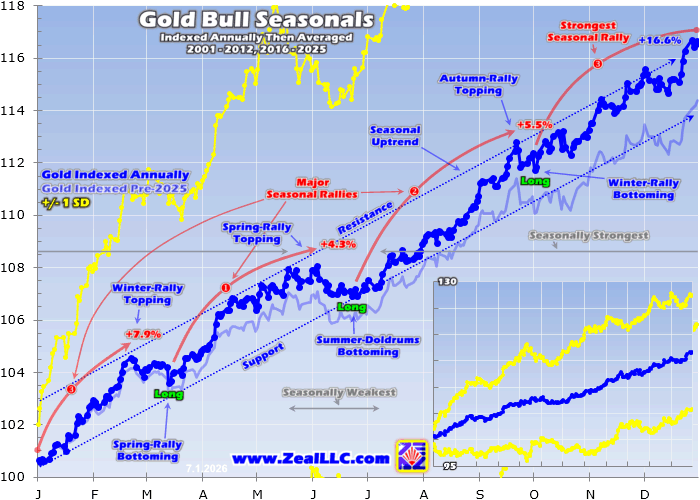
This next chart is updated from my latest gold-seasonals research in mid-April. It shows gold’s average indexed seasonals over these same 22 gold-bull years since 2001. Gold’s summer doldrums almost entirely in June lead to the launchpad into gold’s big autumn, winter, and spring seasonal rallies. They are driven by well-known recurring income-cycle and cultural drivers of outsized gold demand around the world.
On average from 2001 to 2012 and 2016 to 2025, gold’s autumn, winter, and spring seasonal rallies achieved big 5.5%, 7.9%, and 4.3% gains! The autumn rally kicks off these sequential rallies, usually running from late June’s summer-doldrums low to late September. Its main recurring drivers are post-harvest buying by Indian farmers followed by Indian-wedding-season buying during India’s auspicious festivals.
And because of that mean-reversion principle inherent across markets, generally the more oversold and bombed-out gold gets in the summer doldrums the bigger the subsequent autumn rally. Especially if gold has just suffered a multi-month drawdown out of overbought conditions, like this year’s starting in late January. Gold again had a 26.0% drawdown over 4.8 months to a 3.7-year secular oversoldness low in late June!
Whether normal Indian seasonal demand fuels this year’s likely-outsized autumn rally remains to be seen though. Indians are shrewd price-conscious gold buyers who love relatively-low prices. Gold back in the low $4,000s after soaring well over $5,000 earlier this year certainly qualifies! Yet India’s government is trying to clamp down on Indian gold imports, more than doubling import duties on gold to 15% in mid-May!
Why? India is the world’s third-largest oil importer, relying on imports for a whopping 7/8ths of its oil demand! About half of that came from the Persian Gulf before Trump’s war, which dramatically slashed oil flows from that region. India sells rupees to buy oil, which hammered its currency to record lows against the dollar. Yet India can’t restrict oil, so it went after its second-biggest import gold to try to stem that crisis.
While Indians have always had a deep cultural affinity for gold, they can live without more gold jewelry. But without sufficient oil, India’s economy would grind to a halt. In mid-May analysts estimated that India’s gold demand would fall by about 25% in 2026 after that huge import-tax hike. But that was when gold was still near $4,700. At recent way-lower prices, Indians may be more willing to stomach that 9% duty jump.
Yet gold enjoying an outsized autumn rally this year doesn’t rely on Indian buying at all. There are two huge sources of gold demand that will increasingly activate as gold rebounds higher. The first is gold-futures buying by American speculators. Their trading often dominates short-term gold price action, due to the extreme leverage inherent in that realm. Margin requirements left that as high as 19.8x midweek!
As of their latest weekly report, total spec gold-futures long contracts or upside bets on gold were only 3% above a deep 3.5-year secular low seen in late May! That means these super-leveraged traders have massive room to buy and chase any gold mean reversion, which will really amplify it. To rebuild their longs back to recent years’ highs, specs would have to do the equivalent of 575 metric tons of gold buying!
For comparison, through all of 2025 not just its autumn rally Indian consumer gold demand including both jewelry and investment buying totaled 721t according to the World Gold Council. If that falls 25% in 2026 due to that tariff hike, it would make for a 180t shortfall. Potential American gold-futures buying alone dwarfs that. And there’s a second big source of gold demand from American stock investors via gold ETFs.
The US GLD, IAU, and GLDM are world-dominant, with their bullion holdings accounting for nearly 3/7ths of the global physically-backed-gold-ETF total exiting Q1 per the WGC! In late February before the worst of gold’s drawdown, GLD+IAU+GLDM’s holdings peaked at 1,803t. Investors love chasing winners, so gold-ETF holdings grow as gold rallies but shrink when it declines. So investors have been gradually leaving.
By midweek GLD+IAU+GLDM had suffered a relatively-mild 6.8% or 122t draw over the past 4.1 months. Once gold resumes climbing on balance probably in its imminent autumn rally, American stock investors should start shifting capital back into these leading gold ETFs. Their holdings could easily regain 100t+ in coming months, which would offset a big chunk of any waning Indian demand due to those high tariffs.
But the potential GLD+IAU+GLDM build is far larger, especially if these AI-bubble stock markets finally begin rolling over decisively. The euphoria surrounding the epic AI-datacenter buildout has seriously overshadowed gold, leaving it ignored and out of favor. Investors don’t care about prudently diversifying their tech-stock-dominated portfolios with gold when those stocks are thriving, only when they are bleeding.
Midweek GLD+IAU+GLDM holdings were worth $218b, certainly a big chunk of change. Yet relative to US stock markets, that remains trivial. The combined market capitalizations of all S&P 500 stocks are now running a staggering $68,036b. That implies American stock investors’ gold portfolio allocations are way down near 0.32%, only one-third of one percent! So they have vast room to buy if they get motivated.
And plenty of gold analysts aren’t convinced India’s import-tariff hike will crush Indian gold demand. That jump from 6% to 15% import taxes is huge, but it was just in July 2024 when they were slashed from that same 15% to 6%. In 2022 and 2023 with high duties, Indian consumer gold demand totaled 774t and 761t according to the WGC’s fantastic data. In 2024 half with high tariffs and half without, demand ran 803t.
In 2025 with lower duties yet much-higher average gold prices, that again weighed in near 721t. Indian gold demand fared just fine with these same high tariffs, and looks more sensitive to gold prices than taxes. Some Indian gold experts believe higher tariffs are self-defeating since they encourage widespread gold smuggling. Today’s lower gold prices could still very well spawn outsized Indian autumn buying anyway.
So gold’s anomalous deep summer-doldrums lows leading into its usual seasonal launchpad starting with its strong autumn rally are very bullish. Between usual Indian post-harvest and wedding-season buying, American gold-futures speculators rebuilding their really-low longs, and American stock investors upping their trivial gold allocations, there’s big potential gold demand in coming months especially if gold really rallies.
And it ought to after just getting slammed to its most-oversold levels in years on the FOMC doing nothing at all! So this year’s seasonal juncture between the low-volume summer doldrums and autumn rally sure looks like a great buying opportunity. Thus we’ve been layering into fundamentally-superior smaller gold miners’ stocks in both our subscription newsletters, which should really amplify gold’s gains in coming months.
Successful trading demands always staying informed on markets, to understand opportunities as they arise. We can help! For decades we’ve published popular weekly and monthly newsletters focused on contrarian speculation and investment. They draw on my vast experience, knowledge, wisdom, and ongoing research to explain what’s going on in the markets, why, and how to trade them with specific stocks.
Our holistic integrated contrarian approach has proven very successful, and you can reap the benefits for only $12 an issue. We extensively research gold and silver miners to find cheap fundamentally-superior mid-tiers and juniors with outsized upside potential. Sign up for free e-mail notifications when we publish new content. Even better, subscribe today to our acclaimed newsletters and start growing smarter and richer!
The bottom line is gold is nearing its seasonal launchpad with a very-bullish setup. After plummeting in June on irrational Fed-rate-hike fears, gold hit its most-oversold levels in nearly four years. That severe of selloff unjustified by any FOMC actions would be highly unlikely outside of gold’s low-volume summer-doldrums weak season. Resulting anomalous lows shouldn’t last long as gold’s strong autumn rally gets marching.
That’s normally fueled by big Indian gold demand, which might weaken this year on big import-tariff hikes. But lower gold prices and smuggling could very well overcome them. And as gold mean reverts higher, both American gold-futures speculators and American stock investors have vast room to buy and chase it higher amplifying its gains. Overdue weaker stock markets out of this epic AI bubble would accelerate that.
Adam Hamilton, CPA July 3, 2026 Subscribe |
|||||||
|
|
|
|
|
|
|
|
|
|
|
|
|
|
|
|||