
Gold’s Usual Autumn Pullback
Adam Hamilton October 2, 2026 2047 Words
Gold has suffered a sizable selloff since late August, ramping herd bearishness. That retreat was justified on multiple fronts, including gold mean reverting after a blistering rally and something of a mini-mania in Fed-rate-hike expectations. Yet regardless of recent drivers, gold has long tended to pull back in this same early-autumn timeframe. That’s healthy, rebalancing sentiment ahead of gold’s big seasonal winter rally.
From late August to late September, gold plunged 11.7% making for a formal correction! Naturally such a considerable decline compressed into such a short span has utterly squashed August’s bullish psychology. Traders are now expecting gold to continue grinding lower on balance, which is normal after sizable selloffs. Yet like usual traders’ recency bias will cause them to miss another good buying opportunity.
Succumbing to that bias means buying high after big rallies then selling low after big drawdowns. That’s the exact opposite of the buy-low-sell-high mission necessary to succeed in multiplying capital in markets. Traders always tend to overweight the importance of the most-recent price action, extrapolating that into the indefinite future. The remedy for this financially-hazardous recency bias is simple, longer perspective.
Before gold’s recent correction, it surged 17.4% higher from mid-July to late August! And nearly 9/10ths of those gains accrued rapidly in August’s first several weeks. That proved a huge month for gold, as it soared initially in a massive breakout from a colossal bullish technical chart pattern. Soon after the US Treasury surprised, declaring it was upping its longer-term bond buying in an attempt to force long yields lower.
Traders viewed that as quantitative-easing-adjacent, as if the Treasury was printing money to buy bonds like the Fed does. That isn’t the case since only central banks can conjure money out of thin air, but it ignited quite a gold bid. In just over three weeks, gold soared a huge 15.2%! The more extreme any move in both distance and time terms, the greater the probability a proportional mean reversion is imminent.
That’s probably the main reason gold fell so hard from late August to late September. Yet that retreat was attributed to soaring Fed-rate-hike odds. Plenty of that 11.7% selloff erupted on days seeing Fed-rate-hike-moving news. Gold’s latest drawdown really started on August 28th, with a 3.1% plunging after Trump’s new Fed chair gave a hawkish speech on fighting inflation at the Fed’s Jackson Hole symposium.
Federal-funds futures had implied a 35% chance the FOMC would hike by 25 basis points at its next mid-September meeting before Kevin Warsh’s half-hour speech, but rocketed to 57% right after! Then the following Jobs Friday September 4th, they surged again on a big upside surprise in US jobs. Those printed up 162k in August, tripling the +53k consensus! So Fed-rate-hike odds surged again from 50% to 67%.
Promoting maximum employment is part of the Fed’s dual mandate from Congress, so monthly jobs are the most-important economic data for influencing the near-future federal-funds-rate trajectory. Then the following week the latest US wholesale and consumer inflation data was released. Despite a neutral PPI across its four key metrics, September’s 25bp-hike odds surged from 60% before that report to 76% after!
Gold plunged another 1.7% that day. The next morning the latest CPI print also proved pretty neutral, with three of its four key metrics in-line with economists’ expectations and only one 0.1% warmer. Yet Fed-rate-hike odds kept soaring from 69% leading into that data to 91% in its immediate wake! Traders had priced in a certainty of a Fed rate hike in mid-September, which would be its first one in fully 3.1 years.
From the close before Warsh’s Jackson Hole speech to FOMC Eve, gold had fallen 6.7% on those Fed-rate-hike odds skyrocketing from 35% to 91%! The morning of that FOMC decision, they climbed further to 95%. The Warsh Fed indeed hiked for the first time since late July 2023, but interestingly after selling off into that hike gold only slipped 0.7%. Then on the next two days it surged back up 1.8% and 0.9% on close.
That was impressive given an actual 25bp rate hike and top Fed officials seeing one more 25bp hike later this year. Had gold held those levels, sentiment would be much better today. But gold resumed sliding losing 1.7% on the 23rd and a serious 3.9% this Monday the 28th. That first down day was driven by strong PMI sentiment surveys of purchasing managers from S&P Global, implying a strong US economy.
The second was more mysterious, with fully 9/10ths of that big down day accruing overnight in overseas trading on no apparent catalysts! Surging US 10-year Treasury yields were mostly blamed later, but that seemed forced. Monday’s at 5.23% which was indeed a 19.2-year secular high still weren’t materially above the 5.20% just two trading days earlier when gold closed 3.5% higher. Other factors had to be at play.
The climbing US Dollar Index was also blamed, as higher yields make the US currency and Treasuries denominated in it more attractive to foreign investors. Yet that didn’t necessarily hold water either. On Monday as gold plummeted 3.9%, the USDX only rallied a modest 0.2%. And its 101.2 close remained under the one two trading days earlier before gold’s anomalous drop. That rationalization doesn’t fit price action.
So likely weak seasonals played some kind of role in gold’s recent selloff. Though peripheral behind that soaring-rate-hike-odds-induced selling, it is perfectly normal for gold to retreat significantly this time of the year. This gold-bull-seasonals chart distills down gold’s price action in all modern gold-bull years from 2001 to 2012 and 2016 to 2025. Every year is individually indexed to the prior year’s close, which is recast at 100.
Then all those individual-year indexes are averaged together, revealing gold’s bull-market seasonality in perfectly-comparable percentage terms. They show gold has three distinct seasonal rallies, an autumn, winter, and spring one. These are punctuated by seasonal pullbacks. Gold normally weakens from late September to early October. That bleeds away autumn-rally greed paving the way for gold’s big winter rally.
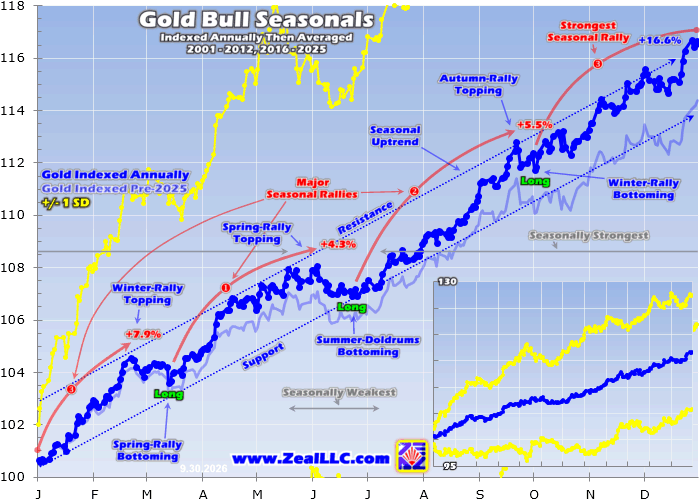
Gold’s autumn rally runs from about late June to late September, averaging good 5.5% gains across this long grouping of 22 bull years. Like all material seasonal moves, this year’s autumn rally varied from that long-term average. Gold almost bottomed in late June after Warsh talked a big hawkish game at his first FOMC meeting in charge. But it later carved a marginally-lower low in mid-July, just 0.5% under late June’s.
From there gold blasted that 17.4% higher mostly in August, more than tripling its usual autumn-rally gains! Such a big surge compressed into such a short timeframe greatly increased the odds gold’s usual seasonal pullback from late September to early October would prove much larger. With way more herd greed generated, a bigger reckoning would be necessary to help rebalance that unhealthy sentiment.
Gold’s pullback this time of year between its autumn and winter rallies merely averaged 0.5% across all these modern gold-bull years. This latest one proved far larger than normal at that 11.7%, and was really pulled forward starting in late August instead of late September! While catalyzed by soaring Fed-rate-hike odds, that way-bigger and earlier seasonal retreat accomplished the same mission as usual this time of year.
Speculators and investors were waxing too greedy and bullish in late August as gold soared. That risked prematurely burning out what looks like a young new bull market underway, attracting in too much buying too soon. So a sizable selloff was necessary to eradicate greed, which is exactly what happened since. Today traders have grown quite bearish on gold, expecting its recent selling to persist indefinitely on balance.
But odds are gold is bottoming here ahead of its usual winter rally. That’s the longest and strongest seasonal one of the entire year, averaging hefty 7.9% gains from early October to late February through modern gold-bull years! January and November are actually gold’s strongest calendar months of the year seasonally, averaging 2.8% and 2.0% gains. Yet winter-rally seasonals are gold’s least-important bullish driver today.
Universally across financial markets, herd sentiment perpetually oscillates between greed and fear. The same is true in economic psychology, including how traders view the likely federal-funds-rate trajectory. When they all crowd onto one extreme side, a mean reversion the other way is imminent to restore balance. Fed-rate-hike odds also act like a pendulum, which is sure overdue to swing back the other way.
In less than three weeks, Fed-rate-hike odds skyrocketed from 35% to 95% on FOMC Day due to one short speech by the Fed chairman, one big jobs upside surprise, and pretty-neutral inflation data! All it will take to quickly hammer them back down is some less-hawkish Fedspeak, a jobs-data mean-reversion lower to a sizable miss, or cooler inflation data. All are quite possible if not probable in coming weeks, a big shift.
This Tuesday futures were still pricing in a 70% chance the FOMC hikes another 25bp at its next meeting in late October, just six days before US midterm elections. But since 1990, the Fed has never once hiked at an October meeting heading into early-November voting! Soon this recent mini-mania of frenzied Fed-rate-hike expectations will pass, which will weigh on the US dollar and likely spawn big gold-futures buying.
Gold-futures speculators wield way-outsized influence on short-term gold price action due to the extreme leverage they run. Midweek that is allowed as high as 20.1x with current margin requirements! That enables each dollar of capital traded in gold futures at max leverage to exert 20x the price impact on gold as a dollar invested outright! And the latest spec gold-futures-positioning data remains very bullish for gold.
Total spec longs, upside bets on gold, are only running 28% up into their trading range during the late monster record gold bull that climaxed in late January! That implies they have big room to buy, major capital firepower ready to throw into gold futures really amplifying any gold rally. That ought to soon be unleashed as that irrational soaring-rate-hike-odds frenzy passes, catapulting gold higher in coming months.
In addition to that, identifiable gold investment demand remains robust despite gold’s sharp recent selloff. American stock investors for example have fueled 12 consecutive weeks of bullion holdings builds in the giant world-dominant GLD, IAU, and GLDM gold ETFs! And American stock investors’ implied gold portfolio allocations remain super-low, on the order of one-third of one-percent! So they have vast room to buy.
Considered together, all this ought to smash the recency bias by revealing gold’s near-term outlook is actually quite bullish contrary to herd sentiment. So after some of our newsletter gold-stock trades were stopped out at big gains, we’ve been aggressively refilling our trading books. We’ve been adding good smaller fundamentally-superior mid-tier and junior gold miners with strong growth outlooks and low valuations.
Successful trading demands always staying informed on markets, to understand opportunities as they arise. We can help! For decades we’ve published popular weekly and monthly newsletters focused on contrarian speculation and investment. They draw on my vast experience, knowledge, wisdom, and ongoing research to explain what’s going on in the markets, why, and how to trade them with specific stocks.
Our holistic integrated contrarian approach has proven very successful, and you can reap the benefits for only $12 an issue. We extensively research gold and silver miners to find cheap fundamentally-superior mid-tiers and juniors with outsized upside potential. Sign up for free e-mail notifications when we publish new content. Even better, subscribe today to our acclaimed newsletters and start growing smarter and richer!
The bottom line is gold’s recent selloff seems like a typical-yet-outsized seasonal pullback. After soaring in August, gold needed some mean-reversion selling to rebalance sentiment. That was exacerbated by a mini-mania in Fed-rate-hike expectations, which has run its course and will soon reverse. Resulting gold-futures buying will amplify gold’s normal winter rally in coming months, already its strongest seasonal one.
Super-leveraged gold-futures speculators have big room to buy and accelerate gold’s gains, as their longs positioning remains relatively low. And after investors’ solid and consistent gold buying for several months, they’re likely to continue shifting capital into gold. It won’t take much less-hawkish Fedspeak or weaker economic data to slash Fed-rate-hike odds, hit the US dollar, and ignite gold’s next major surge higher.
Adam Hamilton, CPA October 2, 2026 Subscribe at www.zealllc.com/subscribe.htm
