|
|
|||||||
|
|
|
|
|
|
|
|
|
|
|
|
|
|
|
|
|
|
|
Warsh Fed to Liberate Gold? Adam Hamilton June 19, 2026 2737 Words
Trump’s new Fed chair helmed his first FOMC meeting midweek. Kevin Warsh came across as hawkish in his post-decision press conference, laser-focused on fighting inflation implying a higher federal-funds-rate trajectory ahead. That slammed gold, like after many past hawkish FOMC meetings. Yet traders myopically ignored Warsh’s overarching new direction for the Fed, which could actually liberate gold from it.
For over a quarter-century now, I’ve been intensely studying and actively trading gold and its miners’ stocks and writing financial newsletters about it all. That includes closely watching and analyzing all material gold price action and its drivers in real-time, to better game future moves. Unfortunately that includes Fed officials’ jawboning, Fed actions, and what traders think the Fed is likely to do based on major economic data.
Over long years those Fed factors have fueled so many big-and-fast gold moves that excelling in gold trading is impossible without becoming a dedicated Fed watcher. The Federal Open Market Committee making monetary-policy decisions meets eight times per year, about every six weeks. Those decisions are released on Wednesday afternoons, after which the Fed chair has held press conferences since April 2011.
So I always block out a couple hours on Fed days to carefully study the FOMC statements and related economic projections from top Fed officials, then watch the Fed chairs’ entire pressers live. Those can get really interesting, and shape traders’ perceptions of shifting federal-funds-rate trajectories which can really move markets. All Fed watchers were super-interested to see what Trump’s new Fed chair would say.
Gold was having a good day leading into Wednesday’s 2pm FOMC decision, rallying 1.1% intraday to $4,380. But within minutes of the statement’s release, gold plummeted 2.3% to $4,280! Later as Warsh answered Fed reporters’ questions, gold dropped as low as $4,220 before recovering some to close down 1.6% at $4,263. That sure made it look like Warsh’s new direction for the Fed will prove bearish for gold!
The FOMC didn’t hike rates, and didn’t even overtly threaten to hike rates. Kevin Warsh has long been a critic of central bankers overcommunicating, and his first FOMC statement reflected that. It was slashed dramatically to just three short paragraphs and a sentence, 130 words compared to the prior one’s 341! And the final sentence of Warsh’s maiden one was unusually emphatic, “The Committee will deliver price stability.”
With every other FOMC decision, the Fed releases a Summary of Economic Projections which aggregate individual top Fed officials’ outlooks on key data including the federal-funds rate and PCE inflation. Traders closely watch the FFR projections, which are individually charted on the dot plot. Wednesday’s first under Warsh upped the year-end-2026 FFR outlook by 40 basis points to 3.8%, implying one rate hike this year.
It also included only 18 dots, though there are 19 Fed governors and regional Fed presidents participating on the FOMC. Later in his press conference, Kevin Warsh said he didn’t submit any economic projections. Those latest dots did shift hawkish from a quarter earlier. The number of Fed guys seeing one or two rate cuts in 2026 fell from 9 to 1, while the number now expecting one or two rate hikes jumped from 0 to 8!
Still dots implying one rate hike late this year shouldn’t have surprised gold traders at all. Less than two weeks earlier, gold had plummeted 3.7% on a big upside surprise in monthly US jobs. That implied the US jobs market was stronger than thought, so the Fed would likely focus on the price-stability side of its dual mandate from Congress. Last week I wrote an essay on that and resulting irrational gold Fed fears flaring.
After that major jobs beat, by that Jobs Friday close federal-funds futures were pricing in a single 25bp hike by year-end! So top Fed officials’ FFR outlooks confirming that less than two weeks later shouldn’t have moved gold at all. The mechanism through which shifting implied federal-funds-rate trajectories move gold center around the US dollar’s reactions to Fed-related news and resulting gold-futures trading.
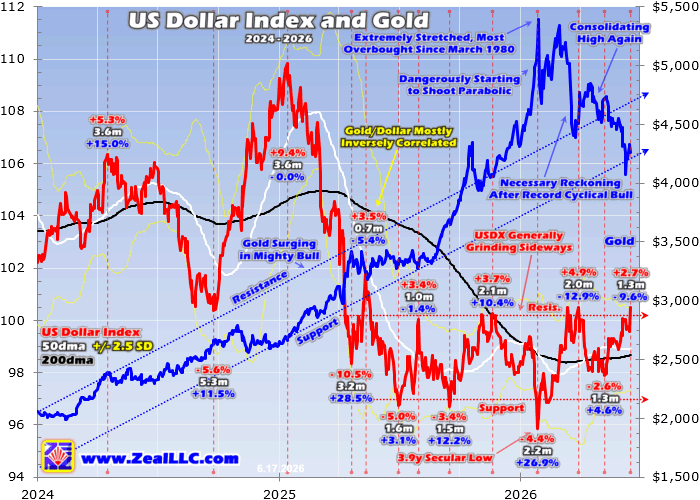
Gold-futures speculators wield outsized influence on short-term gold price action because of the extreme leverage inherent in that realm. They often look to the dollar as their primary trading cue. Fed-hawkish news implying higher rates coming goose the dollar higher, unleashing gold-futures selling. Gold’s 3.7% Jobs Friday plunge coincided with a 0.7% US Dollar Index surge to 100.1, and the dollar was stronger post-Fed.
The USDX blasted up 0.9% to 100.5 on Warsh’s maiden FOMC meeting at the helm, the dollar’s biggest daily rally since March’s first trading day right after Trump launched his war on Iran. So gold’s 1.6% Fed-day drop was comparatively resilient. Gold has long been usually inversely correlated with the USDX’s big swings, as apparent in this updated chart from last week’s essay. A stronger dollar often weighs on gold.
Fully 6/7ths of gold’s Fed-day selloff Wednesday came after the FOMC statement and dot plot, but before Kevin Warsh’s first press conference! Fed watchers didn’t know what to expect from that given his stance on top Fed officials talking too much. He could’ve read a brief statement, taken no questions from the assembled Fed reporters, and left the podium in five minutes. Yet instead he went the distance with a full one.
After intently watching many dozens of these live on CNBC or Bloomberg, I was really impressed with Warsh. He came across as super-smart, articulate, direct, clear, and likeable with a little humor mixed in! It was amazing how many changes he wants to bring to how the FOMC does things. I’m still digesting everything he said, but could easily fill several essays with the many implications for markets of Warsh’s direction.
But the main takeaway for me as a longtime gold analyst is the Warsh Fed could actually liberate gold from long Fed tyranny. He envisions and is moving towards a Fed regime where big market moves anticipating the Fed’s reactions like gold’s latest Jobs Friday pummeling no longer hold sway! His sweeping changes could persuade gold-futures traders to abandon their unhealthy fixation of worrying about the Fed.
For many years that has heavily distorted gold trading and price action. For example historically higher inflation has always been bullish for gold, fueling higher investment demand. Yet because of traders’ Fed obsession, gold has sold off on plenty of hotter inflation reports in recent years. They implied the FOMC would either have to cut rates slower or hike faster, goosing the US dollar unleashing heavy gold-futures selling.
In his presser Kevin Warsh directly addressed the huge problem of traders trying to game the Fed, really distorting markets. Fox Business’s Fed reporter asked the new Fed chair, “So if you don’t give a lot of ongoing forward guidance won’t the markets have more volatility and shouldn’t Americans have more access into what you’re thinking going forward?” A less-talkative Fed sure wouldn’t be good for Fed reporters.
Warsh’s inspired reply was one of the greatest things I’ve ever heard a Fed chair utter! He said, “So I think financial markets perform best when they react to incoming data. I think the financial markets work less efficiently when they ask a question how will the Federal Reserve react to that incoming information.” While he wasn’t talking about gold, that describes countless big-gold-move days on key economic data.
“The more that markets are paying attention to what’s happening in the real economy, deciding what’s good data and what’s less-good data, the more financial markets can price what they believe is the most likely and what are the tail risks. Financial-market prices are probably the most-important source of information to guide central bankers.” And inarguably the price of gold is one of the top critical market signals.
“But when all the financial markets are doing is reflecting back what we’ve said, then we’re taking the most-important source of information and we’re being blind to it. I’d like us to create a system where those blinders come off, where markets are following data that they efficiently think is reliable.” Gold always should’ve rallied on hotter inflation reports, which would’ve underscored their importance for the Fed.
“And they’ll be watching data, we’ll be watching data, they’ll come with better information through market prices to us, we can make more-informed decisions. But ultimately the goal that I set at the outset, deliver on the price-stability objective that Congress told us to do, that we’ve got to get in the business of doing.” Warsh believes traders’ Fed fixation distorting price moves has made markets way less useful for central bankers!
Efficient markets require trading based on the actual implications of key economic data, not how traders think the FOMC will react to it. And communicating less is a great way to goad traders’ mindset in that direction. While top Fed officials do talk about rates too much, the main offender is that goofy quarterly Summary of Economic Projections that was born in late October 2007. The dot plot is utterly infuriating.
Top Fed officials including multiple Fed chairs themselves have often downplayed the importance of those FFR projections. Yet I can’t even count the number of times gold has moved big right after the latest dot plot implied a different FFR trajectory than traders expected. The great majority of those have been sharp gold selloffs on steeper trajectories, yet most of those projections subsequently never came to pass!
The dot plot has proven notoriously inaccurate at forecasting future FFR levels, as I’ve documented many times over the decades in our newsletters. Yet traders treat those dots as gospel truth, heavily distorting markets. It’s not just the sharp moves right after new dots, but the way those shift sentiment for weeks or even months after. Warsh didn’t explicitly say he’s eliminating those FFR projections, but he probably will.
He didn’t submit his own dot, and he is launching five task forces to change the way the Fed conducts its monetary policy. The first will look at the Fed’s communications. Warsh said that top Fed officials have “discussed possible improvements in the form and function of Fed communications” and will “propose some well-considered changes, including to the SEP”. That will likely eliminate the FFR dots by year-end!
No aggregated individual federal-funds-rate projections from top Fed officials alone would greatly reduce market distortions from FOMC decisions. Wall Street traders, analysts, and economists widely share this view and have talked plenty over the years about many problems the dots bring. Gold’s past price action would’ve looked way different without dots reactions tainting sentiment, stabler with stronger fundamental uptrends.
And that isn’t the only way Warsh’s Fed could liberate gold from Fed-fear tyranny. That new way-shorter FOMC statement effectively abolished the Fed’s forward guidance on its federal-funds rate! Introduced way back in August 2003, it was always problematic to project possible future FFR changes ahead of time. That hems in top Fed officials from reacting to whatever the latest economic data is between FOMC meetings.
Those guys love saying that monetary policy isn’t on a preset course, that their FOMC decisions are data-dependent. Top Fed officials can’t predict the future better than anyone else, so why limit themselves in a fast-changing world? With FOMC meetings every six weeks or so, there’s no need for those statements to imply rate biases. Major fed predictions have been wrong plenty, remember 2021’s “transitory” inflation mess?
Between both the FOMC statement and his presser, Warsh was very forceful asserting price stability is the Fed’s core mission. Again the former ended “The Committee will deliver price stability.” And in his opening remarks, Warsh declared “I am pleased to report that members of the FOMC are unambiguous and unanimous, this Committee will deliver price stability.” He called getting that right the Fed’s “north star”.
Then multiple times answering Fed reporters’ questions, Warsh reemphasized that price-stability mandate for his Fed. That means focusing on fighting inflation and worrying less about jobs. Those monthly US jobs reports that really move markets on implied Fed reactions are really problematic, full of estimates and heavily-revised. Warsh taking the focus off those ought to reduce outsized gold-futures trading on them.
Many times over long years gold has moved big on Jobs Fridays, usually selling off hard like this latest one after better-than-expected jobs up traders’ perceived FFR trajectory. Warsh recognizes that not only distorts markets, but that data is suspect since it always changes after the fact. One of his new Fed task forces is focused on evaluating and improving the information sources top Fed officials use to make their decisions.
Warsh also made interesting comments on the Fed’s inflation target. While he reaffirmed 2% both in the FOMC statement and his presser, he said he focuses on what is “left of the decimal point”. That could’ve simply meant not worrying about small changes in reported inflation month-to-month, which makes lots of sense since those estimates constantly change. But Warsh could’ve been implying something way bigger.
If he doesn’t care about inflation after the decimal, could that mean the Fed’s effective target could shift anywhere from 2.0% to 2.9%? Was that a way of Warsh signaling he may stealthily relax that 2% target, perhaps being comfortable near 3%? Interestingly the Fed’s explicit 2% target has only been around since January 2012. Before that the Fed didn’t even disclose one, so maybe communicating it is counterproductive.
If the Warsh Fed gets comfortable letting inflation run hotter, that will also reduce monthly inflation reports’ impact on gold-futures trading. A more-relaxed or even ambiguous inflation target would leave traders less likely to do outsized trading after PCE, CPI, or PPI surprises in either direction. That would make for less-volatile gold trading after these monthly reports, improving stability and thus sentiment among investors.
Warsh was also asked about future press conferences, and replied with a quote from his mentor who said “Press conferences are useful. But when you have one, you want to make sure you have something important to say.” He said this week’s changes qualified, yet “We made some changes today, I expect more changes to come, and some of those might well be worthy of a press conference.” Will future ones be fewer?
After Kevin Warsh’s first FOMC meeting running the Fed, gold did follow past years’ irrational pattern of plunging on a more-hawkish-than-expected FFR outlook. So it’s understandable traders’ initial view of his reign is bearish for gold. But the new direction he articulated for the Fed in his press conference is the polar opposite. He wants to stem market distortions on traders anticipating Fed reactions rather than real data.
This can be accomplished by communicating much less about future federal-funds-rate trajectories, and would make a world of difference for gold. Imagine if gold didn’t face knee-jerk contrary-to-fundamentals gold-futures-driven plunges after every FOMC decision, monthly US jobs report, and monthly US inflation report! Gold’s trends being less noisy and more stable would greatly improve sentiment attracting more investors.
Successful trading demands always staying informed on markets, to understand opportunities as they arise. We can help! For decades we’ve published popular weekly and monthly newsletters focused on contrarian speculation and investment. They draw on my vast experience, knowledge, wisdom, and ongoing research to explain what’s going on in the markets, why, and how to trade them with specific stocks.
Our holistic integrated contrarian approach has proven very successful, and you can reap the benefits for only $12 an issue. We extensively research gold and silver miners to find cheap fundamentally-superior mid-tiers and juniors with outsized upside potential. Sign up for free e-mail notifications when we publish new content. Even better, subscribe today to our acclaimed newsletters and start growing smarter and richer!
The bottom line is this new Warsh Fed may very well liberate gold from Fed tyranny. For long years gold has suffered sharp selloffs after FOMC decisions and key economic data, on how traders expect they will affect future rate trajectories. Trump’s new Fed chair hates those market distortions, arguing they impair the Fed’s ability to get monetary policy right. Excessive Fed communications are the root of those overreactions.
So Warsh is moving fast to rein those in, starting with slashing the FOMC statements’ length and eliminating forward guidance. He will also probably soon scrap the notoriously-inaccurate dot-plot federal-funds-rate projections. These changes along with others should gradually reduce outsized market moves on perceived-Fed-hawkish news. That would make for fewer gold plunges, improving gold sentiment and demand.
Adam Hamilton, CPA June 19, 2026 Subscribe |
|||||||
|
|
|
|
|
|
|
|
|
|
|
|
|
|
|
|||